Guide to feeding a puppy
Feeding and feeding amounts can be difficult and overwhelming for a new puppy owner. There is a jungle of tips and advice, and there is a lot to think about when getting a new four-legged companion. In this article, we have gathered as much as possible of the knowledge we believe is needed when feeding your puppy.
Raw dog food – the natural choice!
Over thousands of years, the dog's ancestors adapted to a life of searching for prey and scavenged food. Despite the fact that we humans have bred dogs for great appearance and good working traits, we have never bred with the intention of changing the dog's interior. Therefore, easily digestible animal foods that the dog's ancestors adapted to through nature will still provide the best foundation for a healthy and active dog's life.
Raw dog food is natural and nutritious, and is easily absorbed by the dog's body. The raw materials are minimally processed, meaning the nutrients retain their natural structure and are straightforward for the body to recognise and use as energy and building blocks.
VOM PUPPY is developed as a complete feed, and pays special attention to the puppy's development and nutritional needs. The blend is made from chicken, beef tripe, salmon, egg and beef liver. Salmon is a source of the omega-3 fatty acids DHA and EPA. These fatty acids are especially important for the puppy's development of the brain, vision, immune system and nervous system. Chicken is a good source of high-quality protein, and beef liver is rich in vitamins and minerals. In VOM PUPPY and all our complete feeds, bone and cartilage from chicken will be a natural and nutritious part of the feed. Bone is a good source of minerals such as calcium and phosphorus, and cartilage is a source of glucosamine and chondroitin which, among other things, contribute to healthy joints.
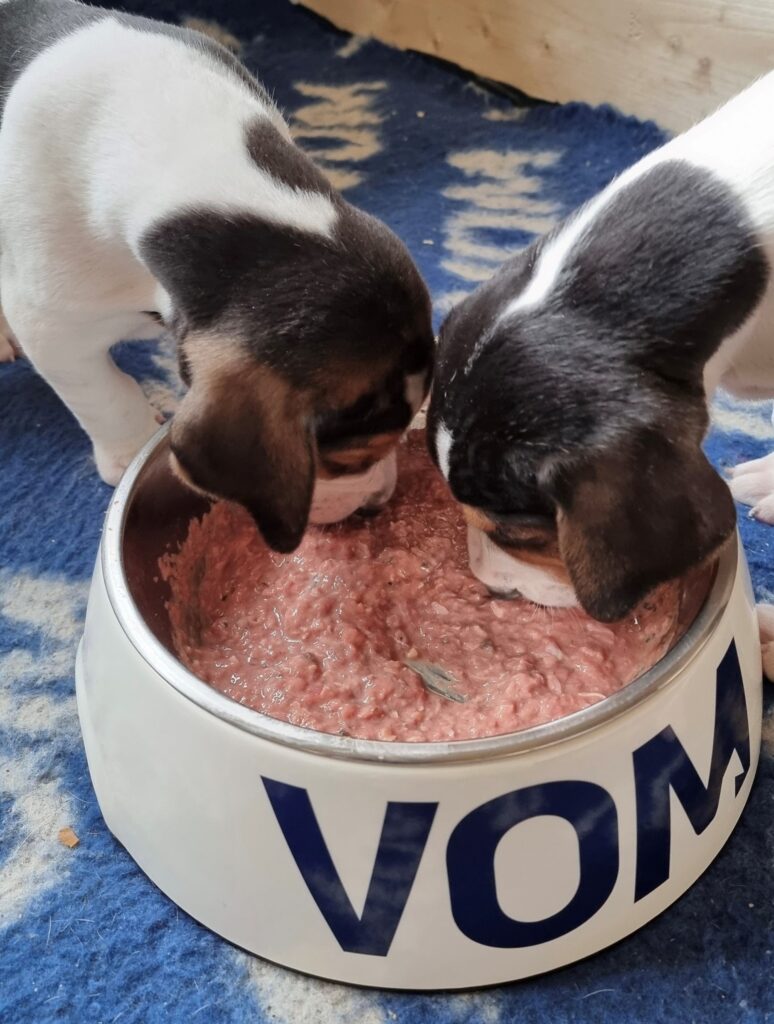
Photo: Erik Hetland
Photo Marianne M. Myrstad
Raw feeding the puppy
VOM Puppy can be introduced to the puppy from 3-4 weeks of age. Our tip when introducing very small puppies to solid food is to mix the food with a little water to get a soup-like consistency. For the very smallest puppies, it may also be appropriate to blend the food into a smoother mixture using a food mixer/blender. We recommend that you do not remove bone or cartilage before serving, as this will affect the balanced content of calcium and phosphorus in the food.
If the puppy has been given VOM PUPPY at the breeder's, you can continue to feed this directly after collection. If you wish to switch to VOM PUPPY from another puppy food, we recommend a gradual transition. Give small amounts at a time over a period of about 1-2 weeks to ensure that the transition goes well.
During upbringing it is natural for the puppy to have periods of both firm and loose motions. Many new impressions and experiences can affect the body and what the puppy's motions look like. That the puppy gets smaller, firmer and drier motions on VOM PUPPY is completely normal. This is because the uptake of the feed is high, and the puppy makes good use of all the nutrients.
Advice and tips on feeding amounts
Every single puppy is different, and even two puppies from the same litter may need a different amount of food each day. The puppy's energy needs depend on several factors, such as breed, age, size, stress and activity level, among others.
Our recommended feeding amount for VOM PUPPY is 4–5% of the puppy’s body weight per day when feeding a complete diet. This is a general and theoretical amount, based on average energy requirements. It is therefore important to experiment and adjust the amount throughout the growth phase. If the puppy is exposed to environmental enrichment, mental stimulation or is very active, it will probably need more food.
As the puppy approaches the halfway point of its growth phase, it is often advisable to reduce the amount to approximately 3.5% of the puppy’s body weight per day. As the puppy nears full maturity, you can gradually reduce this to approximately 2% of the dog’s body weight per day, which is our recommended feeding amount for adult dogs.
The number of meals a puppy will need during the course of a day will vary. The meals should be distributed evenly throughout the day. We recommend three to four meals per day until the puppy is around 3–4 months old. Thereafter, you can gradually reduce to three times a day. When the puppy begins to approach one year of age, it can be given two meals a day.

Hygiene – handling raw dog food
All our feeds, including VOM PUPPY, are made from raw animal ingredients. You can therefore handle VOM in the same way you would handle a raw chicken breast. Use the same hygiene rules that you would use in your own kitchen:
- The products must be stored in a freezer and thawed in a suitable container in a refrigerator. This is important to maintain the high quality until serving. Mainly, the product will have a shelf life of 2-3 days in the refrigerator.
- Use your own utensils such as a knife and chopping board, and wash both hands, equipment and the food bowl thoroughly after use.
The transition from puppy food to adult food
Our recommendation is that the puppy is fed VOM PUPPY primarily until it is fully grown and old enough to begin a transition to adult food. Our puppy food is specially developed for puppies in growth, and takes into account the puppy's development and need for nutrients. However, it is possible to use our other blends occasionally to create a variation in taste.
When the puppy is nearing full growth, it can start the transition to a VOM adult food. As a rule of thumb, you can start with an adult food when the puppy is one year old, but small breeds can also be fully grown earlier and large breeds can keep growing until they are 24 months old. In other words, this depends on which breed you have.
We have a simplified product range with both complete and complementary food in various packaging sizes for adult dogs. These blends are suitable for most dogs regardless of breed, size and activity level.
Read more about our various products.